Prepare a Good Seed Bed
Proper site preparation is critical to successful hydroseed germination and establishment.
Remove large rocks, construction debris, and other obstacles from the area to be hydroseeded.
New lawns should have a minimum of 2 inches of loose, enriched topsoil that is evenly graded to provide a uniform surface for application.
Existing lawns or fields should be mowed short and lightly raked or scarified to improve seed-to-soil contact and promote consistent germination.
Plant at the Right Time Using the Proper Seed Rate
Timing and application rate play a major role in overall success.
Cool-season grasses such as rye or fescue are best planted in the fall or winter when temperatures support steady germination.
Warm-season grasses, including Bermuda and native grass blends, should be planted when soil temperatures are consistently above 68°F.
Seed rates vary depending on seed size, species, and the intended use of the area, such as turf coverage versus pasture or erosion control applications.
Seed Aftercare: Give Your Lawn the Best Start
Planting grass seed is only the first step—proper aftercare is what determines success. Newly seeded lawns are delicate and require the right balance of water, timing, and protection to grow strong, healthy roots. Without correct aftercare, even high-quality seed can fail to germinate or die off before it establishes.
Watering
Watering is critical and requirements vary by season, rainfall, and municipal restrictions in Central Texas and should be adjusted as needed.
Summer Conditions: During hot, dry weather, newly hydroseeded areas should be watered lightly and frequently to keep the soil surface consistently moist. This may require watering 3–4 times per day during the first 2–3 weeks. Durations should be adequate to keep surface consistently damp like a sponge, but avoid heavy watering that causes runoff, erosion, or puddling.
Rainfall Adjustments: Natural rainfall may reduce or eliminate the need for supplemental irrigation. Suspend watering during rainy periods and resume only if the soil surface begins to dry.
Watering Restrictions: Always follow local watering schedules and restrictions. When limitations are in place, adjust irrigation timing and duration to maintain adequate moisture within the allowed watering windows.
As the turf becomes established, gradually reduce watering frequency while increasing depth to encourage deeper, more drought-tolerant root systems.
What to Expect
Small sprouts will appear within 1-4 weeks depending on seed type, if planting instructions are followed.
1-2 weeks for Rye, Fescue, and Teff love grasses
2-4 weeks for Bermuda, Zoysia, and native grasses
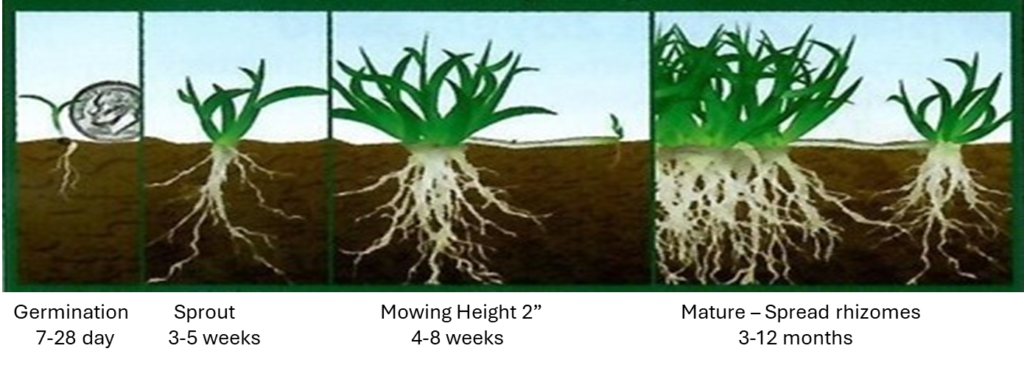
Small plants will grow and develop over the next few weeks with proper watering and sunlight.
Heavy weed growth can inhibit seedling development.
Weeds should be controlled by hand weeding or by applying an appropriate weed control agent.
Be patient, don’t expect quick results, the lawn must grow and mature it’s roots and runners to spread and thicken. It may take up to a full year to mature into full coverage. Good care, mowing, watering and fertilization will accelerate this process.
Initial Growth and Mowing
Care during early growth helps ensure healthy, long-term turf performance.
Germination time varies by seed type and weather conditions, with most grasses emerging within 7–21 days. The blue dye of the hydroseeding will fade within the first week, but the seed, mulch and fertilizer are intact.
Limit foot traffic and equipment use on newly hydroseeded areas until the grass is well established.
Mowing may begin once the grass reaches approximately 3–4 inches in height. Never remove more than one-third of the blade length in a single mowing.
Fertilization
Starter fertilizer is typically included in the hydroseed application; additional fertilization should be delayed until the turf is established after the first mow which is typically after 4 to 5 weeks. Fertilize with a slow-release nitrogen once a month for three months.
Turf Maintenance
Established turf grasses require periodic care to keep things green and heathy.
Water is required to keep the lawn green and growing
Perennial grasses like Bermuda and Buffalo may brown in the heat of the Texas summer
Fertilize turf grasses like Bermuda grass 4 times a year
Fertilize native grasses like buffalo 1-2 times per year
Control weeds by hand or with a broad leaf herbicide (active ingredient – 2,4-D)
Apply a preemergent herbicide November to January.